Federal opt-out rules for texts change on November 25, 2026. A business that texts back unanswered callers is covered by them, and by carrier standards too.
By Clint Sanchez
Many small businesses now send an automatic text when a call goes unanswered. The idea is simple. A caller who reaches voicemail gets a message within seconds, and the conversation moves to text until someone is free.
That text is a business message sent by software. It sits inside a set of federal rules, carrier standards, and registration systems that most owners never read. One of those rules changes this month.
The federal rules that cover business texts
The Telephone Consumer Protection Act is carried out through the FCC’s robocall and robotext rules at 47 CFR 64.1200. The section speaks to calls and text messages side by side.
Three parts matter most to a business that texts. Marketing texts sent by automated systems generally need prior express written consent, defined as a signed agreement with specific disclosures. The Do Not Call rules apply to telemarketing texts sent to wireless numbers. And consumers can take back their consent.
The rule text does not mention missed calls at all. A search of the section for the word returns nothing. That leaves owners applying general rules to a specific setup, which is one reason the details deserve a careful read.
What changes on November 25
Under the version in force today, a consumer can revoke consent by any reasonable method. Replies such as “stop,” “quit,” “end,” “revoke,” “opt out,” “cancel” or “unsubscribe” count automatically. So does other wording a reasonable person would read as a request to stop. A business may not name one exclusive way to opt out.
The FCC changed that in an order published in the Federal Register on October 26, 2026. It was adopted September 30 and takes effect November 25, 2026.
Under the new text, a sender may designate an exclusive opt-out method. For texts, that can be a reply using one of the seven standard words. The sender has to disclose the method clearly in the text. Including at least one of those words in each message satisfies that, as long as the sender honors any of the seven.
A sender that designates an exclusive method does not have to process requests made other ways. A sender that does not designate one must still honor requests made by any reasonable means. Both paths keep the outer limit of ten business days to honor a request.
The order adds a distinction that fits customer service texts. An opt-out sent in reply to an informational text can be treated as covering only that category of messages. An opt-out sent in reply to a marketing text ends all future marketing texts from that sender.
Opt-out confirmations and carrier standards
The rules also allow one confirmation text after an opt-out. It has to confirm the request and nothing more, with no marketing. A confirmation sent within five minutes is presumed to fall within the consumer’s consent.
Carriers add their own layer. CTIA, the wireless industry association, publishes Messaging Principles and Best Practices, last revised in May 2023. They are not law, and CTIA says they do not convey legal advice. They do shape how carriers and their partners treat business traffic.
CTIA sorts business texts into three groups. A conversational text is a reply to a consumer who texted first, and CTIA says no additional permission is expected. Informational texts follow a consumer giving a number and asking to be contacted. Promotional texts call for written agreement.
A missed call does not fit neatly into the first group. CTIA’s description is about a consumer who sends a text first, and the document does not address a voice call that went unanswered. That gap is worth raising with counsel before an automated reply goes live.
CTIA also asks senders to identify the organization in the initial message, to use standard “STOP” wording, and to act on plain-language requests such as “please opt me out.”
Registration happens before the first text
Most small businesses text from an ordinary 10-digit number. Carriers treat software-sent traffic from those numbers as a separate channel called 10DLC.
The Campaign Registry describes 10DLC as a channel in which brands and their messaging providers are verified before they are allowed to send. A business cannot register directly with the registry. It registers through a messaging provider, which submits the brand and its campaign on the business’s behalf.
For an owner, the practical question is simple. The texting tool in use should be able to show that the business and its missed-call campaign are registered.
What the complaint data shows
Consumers use the FCC’s complaint system for unwanted texts in large numbers. In the FCC’s public complaint data, filings marked as text messages reached 29,825 in 2024, about two and a half times the 12,001 filed in 2023.
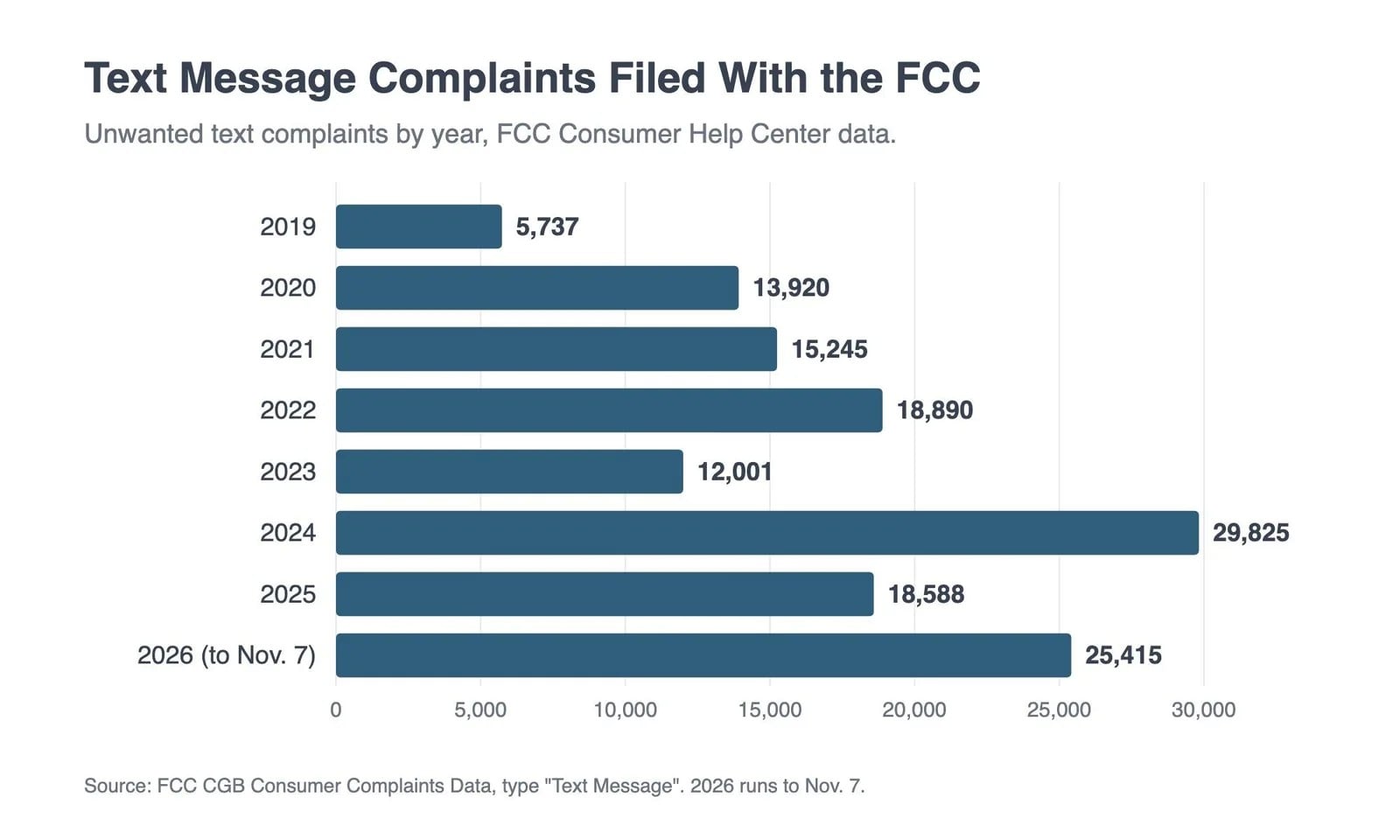
Text message complaints in FCC Consumer Help Center data, by year.
The count fell to 18,588 in 2025. Through November 7, 2026, it already stood at 25,415. The FCC notes that it does not verify the facts in these complaints, so the figures show consumer frustration, not proven violations.
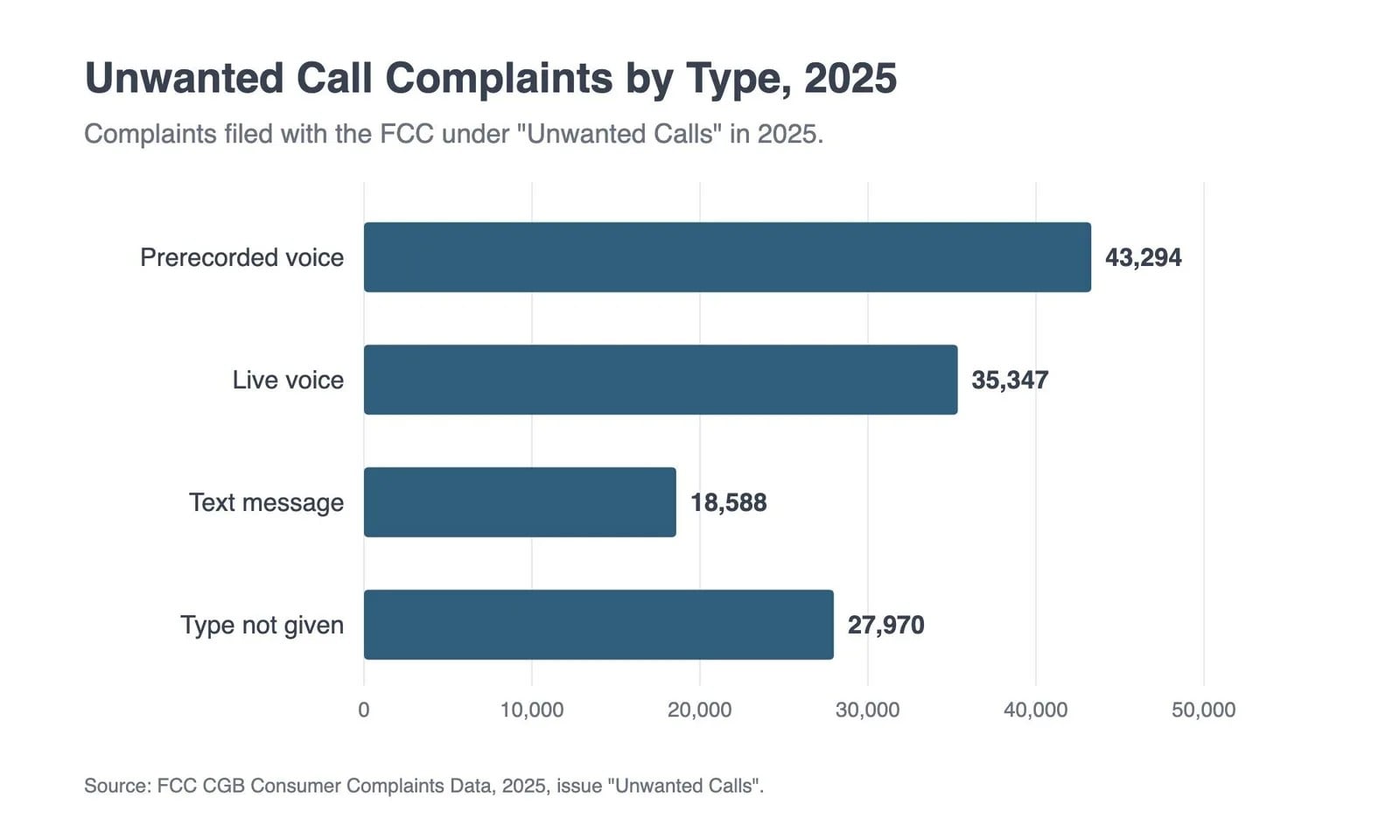
FCC unwanted call complaints by type, 2025.
Texts made up about 15% of the 125,199 unwanted-call complaints filed in 2025, by our arithmetic. The FCC’s rules also let it order mobile carriers to block texts from numbers it has found to be sending illegal messages.
A working checklist before the text goes out
None of this replaces legal advice, and a business with questions should confirm its setup with counsel. The sources above point to a short list of items to check:
- Confirm the number and the missed-call campaign are registered through the texting provider.
- Name the business in the first message.
- Keep the reply about the caller’s request, with no offers or promotions.
- Include an opt-out word such as STOP in the message.
- Make sure every standard opt-out word is honored, and plain-language requests too.
- Send no more than one confirmation after an opt-out.
- Keep records of opt-ins and opt-outs.
Owners comparing setups can start with a breakdown of missed call recovery for service businesses, which covers how an automatic text, caller tagging, and callback reminders fit together on the number a business already uses.
The text itself is usually one or two lines. The rules around it are longer, and after November 25, they will look slightly different from the ones most guides describe.
